


Neurofinance studies how investment decisions arise not only from reason but from circuits involving dopamine and reward anticipation, the amygdala and fear, and the prefrontal cortex as a brake. Financial interfaces can trigger these circuits through colours, notifications, gamification and dark patterns, encouraging more frequent trading. This article examines that architecture and the proposed antidotes of quiet finance and positive friction.
Can Interfaces Manipulate Investment Decisions?
In March 2022, an analytically skilled 29-year-old software developer invested all his savings, following months of research, in a memecoin gaining momentum on social media. It looked rational: charts rose, the community was excited and the fear-and-greed index was high. Within 72 hours the market reversed. When his portfolio lost 92%, calm gave way to fast breathing, sweaty palms and panic. With shaking fingers he pressed Sell.
This was not weak willpower but modern finance's darker secret: neurofinance.
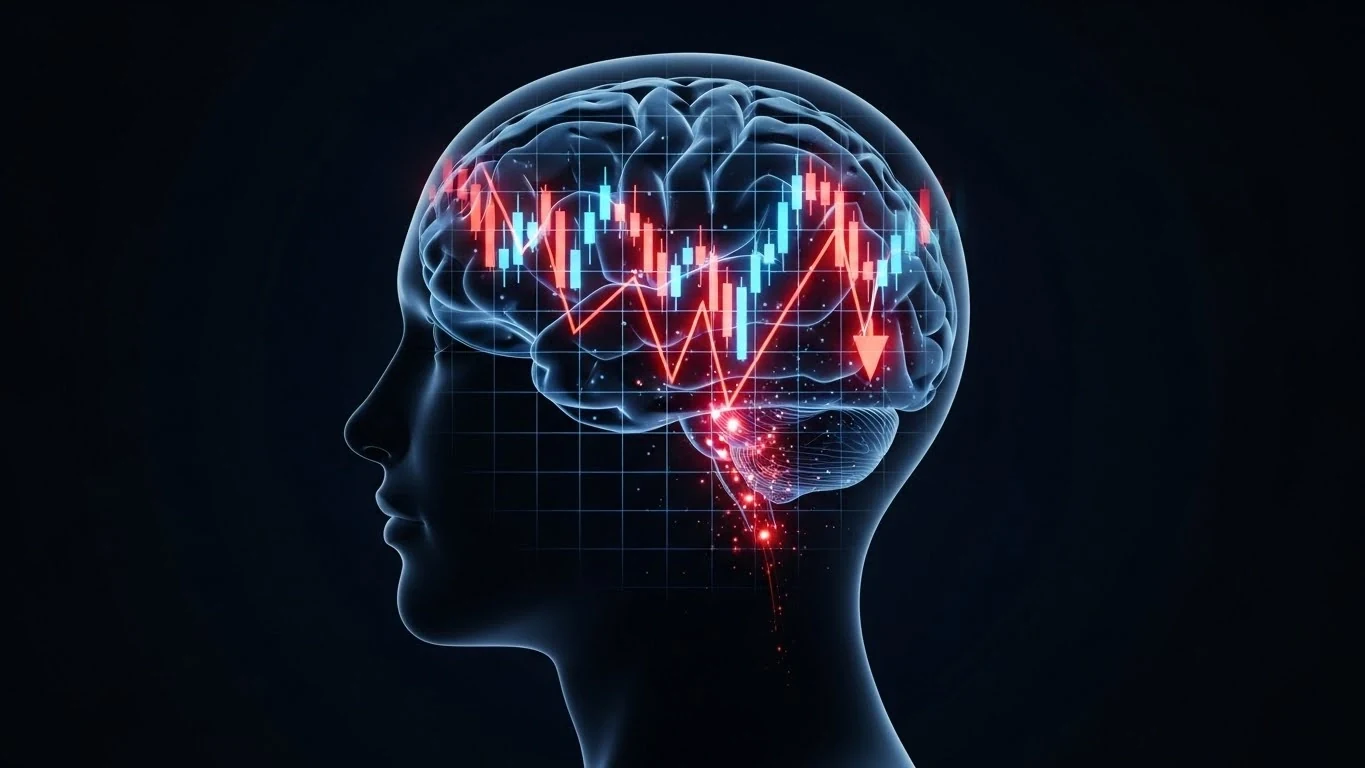
Had he been connected to an fMRI scanner, it would have revealed the amygdala, the fear-and-threat centre, sounding an alarm as if facing a lion. Yet there was no predator, weapon or cliff—only a chart, a falling red arrow and flickering numbers.
Was the response a mistake? Or the result of 300-million-year-old hardware interacting with modern software? Were the colours, arrows and notification tones accidental? Neurofinance literature offers an unsettling answer: they were deliberate stimuli intended to trigger primitive circuits, bypass rational control and produce impulsive reactions.
Who Makes Financial Decisions: Consciousness or Autopilot?
Discussion often reduces neurofinance to “brain scans plus investing apps equals better decisions”. The missed question is: Does the conscious self decide, or do automatic, emotional, evolutionary circuits?
Modern economic theories assume rational decision-making. Neuroscience challenges that account: most decisions occur in fast, automatic, emotional “System 1” before awareness.
Financial interfaces are designed to monetise that autopilot's weaknesses rather than make you more rational. Recognising that 90% of mistakes may be governed by the primitive limbic system rather than conscious will can feel like a mental hijacking. Neurofinance then becomes a defensive skill, not merely an academic field.
Neurofinance: Shield or Perfect Trap?
“User-friendly” can be strategic camouflage. The language of democratising investment used by Robinhood and similar platforms can package neurobiological manipulation. These systems are designed not simply to improve UX, but to trigger primitive circuits, encourage frequent transactions and generate more fees.
The ethical question is stark: Is designing a financial interface equivalent to designing a legal drug?
Laboratory findings make the comparison more than rhetorical. Brain scans show activity from a US$100 stock gain firing the same receptors with similar intensity as cocaine or sexual arousal. If a button's colour or digital confetti uses the same dopamine pathway as an addictive substance, where does a designer's responsibility begin and end?
Beyond conventional UX discussion, interfaces can become sophisticated mechanisms of behavioural dependence rather than rational investing tools. This examination brings research together to expose the neural mechanisms behind financial decisions.
Is Money a Neurotransmitter?
1. Reward Centres and the Chemistry of Money
“Money is a neurotransmitter.” The phrase sounds metaphorical but points to a neurobiological reality. We have no brain region evolved specifically for money. Instead, reward circuits evolved for biological survival—food, water and life—have been repurposed to process it.
2. NAcc: Desire and Anticipation
The nucleus accumbens (NAcc), deep in the brain, is central to motivation, pleasure and reward anticipation. Brian Knutson's fMRI research demonstrated increased blood flow there when people faced the prospect of monetary gains.
The crucial finding: NAcc reacts more strongly to anticipation than reward itself. A chart suggesting future gains may produce more dopamine than selling for a profit. Notifications, “top gainers” and “opportunity” alerts repeatedly trigger this mechanism and keep people anticipating.
| Neurotransmitter / region | Biological role | Financial equivalent and interface trigger |
| Dopamine / nucleus accumbens | Reward seeking, motivation, learning | Top gainers, green, confetti, push alerts |
| Serotonin | Mood regulation, impulse control | Regret after loss, fear of lost status, panic selling |
| Amygdala | Threat, fear, fight or flight | Red arrows, falling portfolios, crash news |
| Anterior insula | Disgust, pain, internal awareness | Loss pain, resistance to realising losses |
| Prefrontal cortex (PFC) | Executive control, planning, inhibition | Long-term planning, cooling-off periods |
3. The Dopamine Cycle and Dependence
Money's neural effect overlaps with stimulants such as nicotine and amphetamine through the mesolimbic dopamine pathway. The brain encodes a US$100 gain as a survival advantage. Modern markets' speed and accessibility can overstimulate this system.
Dopamine works through prediction error: unexpected rewards produce more than expected ones. Market uncertainty is therefore compelling. A guaranteed US$10 per button press would become familiar and lose its effect. Variable wins and losses keep stimulation high—the principle of slot machines, incorporated into trading apps.
4. Loss Aversion and Pain
Loss aversion describes losses hurting roughly twice as much as equivalent gains please us. Neurofinance presents this as more than preference: a form of physical pain.
Possible or actual losses activate the anterior insula, also involved in disgust and pain. A 20% portfolio decline can therefore produce a signal resembling spoiled food or trapping a finger in a door.
Avoiding this pain can cause investors to hold losing positions for years or panic-sell at a low. Experiments at Caltech involving people with amygdala damage found no loss aversion and more rational risk-taking. The account presents this as evidence of fear obstructing financial rationality.
Evolutionary Mismatch
1. Stone Age Brains, Digital Trading
Brains did not evolve to calculate derivatives, read cryptocurrency charts or trade at high frequency. They developed during roughly 2.5 million years of the Pleistocene on African savannahs, where resources were scarce, threats immediate and the future uncertain.
The evolutionary mismatch hypothesis argues that a fast, abstract digital environment differs radically from that setting and produces maladaptive behaviour.
2. Hyperbolic Discounting and Impatience
For ancestors, storing meat was not always sensible because it spoiled or attracted predators. Immediate consumption aided survival. Today this appears as hyperbolic discounting: preferring 50 units now over 100 later. Markets reward patience while brains want immediate reward. One-click trading removes the brakes on this impulse.
3. Herd Behaviour and FOMO
Leaving the group on the savannah could mean death; following it aided survival. Today herd behaviour and fear of missing out can devastate investment decisions. Rapid price rises signal “everyone is doing it; I must too”. “Most bought” and “Trending” lists digitally activate this impulse, often encouraging buying at the top.
4. Making Abstract Threats Concrete
Brains struggle with abstract threats such as future insecurity but respond well to an approaching lion. Interfaces turn numbers into red colours, arrows and charts, “hacking” threat perception. The opening scenario involved not merely a falling number but a red screen interpreted as an approaching danger. The amygdala overrode the PFC and ordered flight—selling. Protective evolutionary hardware became a vulnerability in digital markets.
Manipulation Architecture: Gamification and Dark Patterns
1. The Promise of Protecting Users
Companies market interfaces as friendly, accessible and democratic. Neurofinancial analysis suggests many exploit cognitive weaknesses to increase trading, or churning. These are dark patterns.
2. Robinhood and Confetti
Robinhood turned transactions into a game through gamification. Confetti after a first trade may look innocent but resembles conditioned learning in Skinner-box experiments: pressing a button is paired with a visual reward and becomes repeatable behaviour. The Massachusetts Securities Division's case (news source) describes gamification designed to encourage dopamine-seeking play rather than rational investment. Even after confetti disappeared, colours, sounds and pace targeted the same pathways.
3. Payment for Order Flow: The Incentive
Many commission-free platforms earn not by charging users but by selling orders to market makers: payment for order flow (PFOF). The user becomes the product rather than the customer. Revenue rises with transaction volume, so the interface encourages frequent trading rather than profitable trading.
| Stakeholder | Motivation | Desired behaviour | Neurofinancial design strategy |
| Broker / app | Maximise PFOF revenue | High trading volume | Gamification, alerts, highlighted volatility |
| Market maker | Profit from the spread | Uninformed retail flow | Incentivise brokers through PFOF |
| User | Build wealth | Trade less, hold longer | Quiet finance and positive friction, absent from current interfaces |
Panic and excitement generate volume. The system does not want the user to become more rational, because buy-and-hold investors are not profitable for PFOF.
4. Why Red and Green?
Colour does more than encode information:
- Red: Associated with poison, blood and danger, it activates threat and avoidance, encouraging selling.
- Green: Signals safety and reward; bright neon green can prompt impulsive buying. Research links red with prolonged pessimism and distorted risk perception. Neutral grey or blue could communicate declines if information were the sole aim. The most alarming colours instead encourage action.
5. The Attention Economy
Blinking prices keep attention alert by exploiting the hunter-gatherer reflex to track moving prey or predators. Flashing backgrounds create a hypnotic loop, making the screen difficult to leave. Decision fatigue follows, and tired brains tend towards primitive, impulsive choices.
The Dependence Cycle
1. Neural Overlap: Gambler and Investor
Research finds similarities between pathological gambling, substance dependence and highly active trading: strong NAcc reward anticipation but weaker PFC impulse control.
A sudden 20% stock gain produces a dopamine surge biologically close to a drug's effect. Tolerance develops: an initial 5% gain excites, but later larger risks and more volatile assets such as leverage or memecoins are needed.
2. The Near-Miss Effect
Near misses, such as 7-7-6 on a slot machine, stimulate dopamine through the feeling of almost winning. Finance has equivalents:
An unfilled order and the sense of a missed opportunity.
A stock rising immediately after sale produces regret and a wish to recover. These feel like almost winning rather than simply losing, prompting renewed entry, often with anger and greater risk.
The Antidote: Quiet Finance and Positive Friction
If speed and frictionlessness work against users, what is the answer? Neurofinance suggests the goal is not making people perfectly rational but making autopilot less destructive. Quiet finance and positive friction address that objective.
Positive Friction
Frictionlessness—acting without thinking—can be a trap in finance. Deliberate obstacles can help:
- Confirmation questions: Before selling an entire portfolio or placing a large volatile order, require a statement such as “I ACCEPT THE RISK OF LOSS”. This shifts automatic System 1 towards reflective System 2.
- Cooling-off periods: Grey out Sell for 10 seconds during panic, or temporarily freeze an account during excessive trading.
The Quiet Finance Movement
Some newer apps take the opposite approach to dopamine design:
- Blue and grey: Neutral colours rather than red and green.
- Static interfaces: Hide flashing signals and immediate price changes unless requested.
- Long-term feedback: Show progress towards annual goals rather than daily fluctuations.
The Final Scenario: A Calmer Blue Screen
Return to the panicking developer. What if the app detected hurried movements and screen time, faded to calming blue and replaced the red arrow with “Markets fluctuate. Remember your long-term goal”? What if Sell were disabled for 10 seconds?
Would this rescue him or restrict free will? The neurofinancial perspective argues the amygdala has already hijacked it. Blue does not remove freedom; it gives the PFC time to return to the controls.
Who Is at the Wheel?
Markets are not just exchanges of money but places where primitive fears and desires meet advanced algorithms. Most investors are unarmed because they do not recognise the evolutionary agent steering their minds.
“Have you fallen into this trap?” is not an accusation but an acknowledgement of biology. A brain shaped over 300 million years to escape lions now holds a phone that mimics one.
The main question is no longer which stock to buy. It is: Does this interface feed my amygdala or support my prefrontal cortex?
Financial freedom means not only having money but avoiding becoming a puppet of your biology while managing it. Perhaps the real revolution is taking a breath and questioning screen colour before pressing Sell, rather than trading faster.
Sources:
- https://authors.library.caltech.edu/records/tzvwj-ejb17/files/mmc1.pdf
- https://pmc.ncbi.nlm.nih.gov/articles/PMC3030206/
- https://escholarship.org/content/qt0jq417kn/qt0jq417kn.pdf
- https://en.wikipedia.org/wiki/Evolutionary_mismatch
- https://coconote.app/notes/bfc2fc09-dd36-4bf9-9d75-224aa9163a90/transcript
- https://wire.insiderfinance.io/the-psychology-of-color-in-trading-how-chart-visuals-influence-your-decisions-without-you-9d507ac67aeb
- https://www.idfcfirstacademy.com/blogs/behaviour-finance/neurofinance-the-science-behind-money-decisions
- https://pmc.ncbi.nlm.nih.gov/articles/PMC4150492/
- https://www.caltech.edu/about/news/caltech-neuroscientists-discover-brain-area-responsible-fear-losing-money-1591
- https://journals.plos.org/plosone/article?id=10.1371/journal.pone.0255292
- https://www.perxtech.com/blog/dopamine-domino-effect/
- https://pmc.ncbi.nlm.nih.gov/articles/PMC2033431/
- https://academic.oup.com/scan/article/8/3/341/1723906?login=false
- https://pmc.ncbi.nlm.nih.gov/articles/PMC2840433/
- https://www.researchgate.net/publication/41416827_Amygdala_Damage_Eliminates_Monetary_Loss_Aversion
This examination draws on neuroscience, behavioural economics and FinTech literature, fMRI findings and public legal materials, including Massachusetts Securities Division reports. Its purpose is to help readers understand biological responses to financial stimuli.
Not investment advice: No finding, strategy or quiet-finance approach here constitutes investment advice, financial planning or encouragement to buy or sell an asset. Decisions should reflect individual risk tolerance and professional financial advice.
Sources and bibliography: The cited behavioural neuroscience studies underpin the field. Readers should compare these arguments with the original academic texts listed above.


Comments