

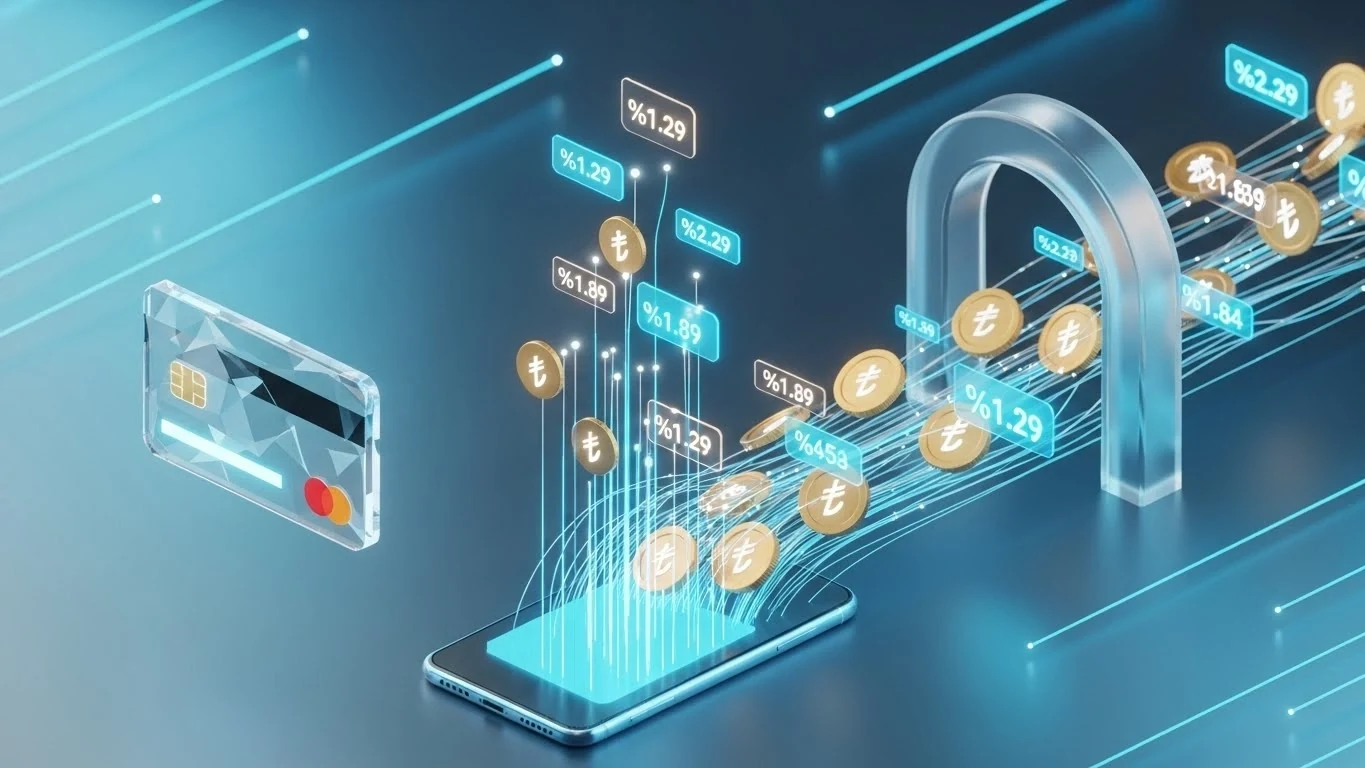
As 2025 ends, e-commerce businesses and SMEs are recalculating profitability. In January 2026, managing payment infrastructure costs is a key way to offset rising operating expenses. Which are the best virtual POS providers? Who offers low commissions and fast settlement? This guide brings together 2026 virtual POS commission rates, New Year offers and details for choosing an appropriate solution.
⚡ 2026 Market Data: A Quick Overview
- Lowest starting commissions: Rates have fallen to 1.29–2.29%.
- Standard settlement: Next-day payment has become the market norm.
- Fastest setup: Providers such as Param and Tami allow payment acceptance in around two hours.
- Hidden costs: Annual and inactivity charges have largely disappeared among FinTech providers in 2026.
2026 Virtual POS Commission Comparison: Summary
Below are leading providers and starting rates applicable in January 2026. The table summarises the options for a quick decision.
| Provider | 2026 starting rate | Settlement | Key feature |
|---|---|---|---|
| Sipay | From 1.69% | Next business day | Global payments and module support |
| Param | From 2.19% | Next business day | 23 banks in one integration |
| PayTR | From 2.19% | Next business day | No subscription, CBRT licence, fast setup |
| QNB Finansbank | From 2.39% | Selectable settlement | 0% for first three months, e-transformation packages |
| Tami | From 2.85% | Next business day | Predictable pricing, fast cash flow |
*Rates are indicative and may change during 2026 with turnover, industry and promotions. Consult providers' official websites for current quotations. The listing is alphabetical. Next-business-day payments depend on the agreed terms.
The Virtual POS Ecosystem
As 2025 ends, businesses and SMEs are recalculating profits. In January 2026, controlling payment infrastructure costs helps offset rising operating expenses. First, however, understand how the system works.
What Is Virtual POS?
Before getting lost in technical terms, let us make the idea clear. Virtual POS (V-POS) is a software-based payment terminal that allows e-commerce websites to accept credit and debit card payments. The most useful way to picture it, however, is as a universal digital interpreter.
Why? Customers arriving at your website speak different financial languages: some use Visa, others Mastercard, Discover or Troy. If your provider—your interpreter—is not capable enough, it understands only certain languages and turns other customers away. A good virtual POS provider is the skilled interpreter at the door. Whatever card language the customer uses, it understands, obtains authorisation from the bank and ultimately delivers the payment to you. You therefore need not take a separate “language course”, or negotiate a separate agreement, with every bank.
The Three Foundations
Three components work behind a transaction:
- V-POS: The digital terminal accepting payment.
- 3D Secure: SMS confirmation to the cardholder's phone, acting as a fraud shield.
- Authorisation: The bank's digital handshake confirming available funds and approving the transaction.
2026 Market Analysis: Banks and FinTechs
Banking as a Service (BaaS) has sharpened the market's division. Businesses face two main paths with different advantages.
Next-Generation Payment Institutions
Param, PayTR and iyzico lead with “one integration, all cards”.
- Main advantage: One contract enables instalments across Turkish card families: World, Bonus, Axess, Maximum, CardFinans, Paraf and Advantage.
- Cost change: Annual subscriptions and setup charges have largely disappeared among FinTechs in 2026.
- Speed: Setup averages two hours at many providers.
Bank Virtual POS Services
Banks such as İş Bankası, Garanti BBVA and Akbank have moved away from cumbersome structures and become more competitive in 2026.
- Advantage: Strong perceived trust and financing options such as releasing blocked funds for existing customers.
- Disadvantage: Instalments generally apply only to the bank's own card family, such as World for Yapı Kredi. Other cards are single-payment transactions. A branch visit may still be required for business registration despite online applications.
Provider Reviews
“Best” depends on business needs. Here is an analysis of strong providers using 2026 data.
1. Param Comprehensive B2B and SME solution
From 2.29%

ParamPOS, among the leading virtual POS providers, accepts payments worldwide. Transactions are checked and approved in milliseconds.
- Why choose it? Integration with 23 banks. Transferring receipts to a Param Business Card and spending them can unlock better rates.
- For whom? SMEs and marketplaces wanting central cash-flow management.
2. Tami Developer-friendly, fast approval
Fixed rate: 2.85%

Tami charges no opening, installation or fixed fee. Once your application has been approved through a digital contract, you can start accepting payments within just two hours.
- Technical strengths: Developer-friendly APIs support fast integration with React, PHP, .NET and iOS.
- International: Foreign-currency payments support cross-border e-commerce.
3. Sipay Dynamic rates and cross-border sales
From 1.69%
Sipay stands out among online payment solutions with commissions adapted to your business's industry and turnover. It does not charge monthly or annual subscription fees.
- Infrastructure: Ready-made modules, strong transaction performance and PCI-DSS compliance. Suitable for selling in different currencies.
4. PayTR Established trust and next-day settlement
From 2.19%
Serving under a CBRT licence for more than 12 years, PayTR offers next-business-day settlement without a turnover threshold.
- Security: Intelligent anti-fraud systems protect against chargeback risks.
5. iyzico Consumer confidence and protected shopping
Tailored quote
The “Protected Shopping” feature builds substantial confidence among end customers and helps remove barriers to completing payment.
- Why choose it? The logo reassures people at checkout and lowers abandonment. Its 24/7 live support is highly effective.
2026 Virtual POS Commissions: Comprehensive List
Rates generally range from 1.19% to 8%, depending on transaction volume and bank agreements.
The following table gives starting rates available under specified conditions.
Bank Virtual POS Analysis
In response to the rise of FinTech institutions, banks are following a more aggressive, segment-specific and promotion-led pricing strategy in 2026 to protect market share. Their “welcome” campaigns may begin at very low rates, but standard tariffs return after a specified period or turnover limit.
The table summarises positions and offers at the start of 2026:
| Bank | Starting / promotional rate | Standard rate | Audience / condition |
|---|---|---|---|
| Garanti BBVA | 1.99–2.39% | 3.56% | First three months or TRY 1.5 million turnover |
| İş Bankası | 1.99–2.04% | 3.74% | Anında POS, up to TRY 3 million |
| Akbank | 1.99% | 3.74% | Digital application, valid six months |
| ING Bank | 0%: Cebimde POS | 3.72% | Card spending limit of TRY 60,000 monthly |
| Halkbank | 3.74% | 3.74%+ | May vary under chamber-of-trades agreements |
In high-interest, high-inflation conditions such as Türkiye's, blocked funds can carry an opportunity cost higher than the commission. Technical capabilities, as well as price, determine efficiency.
A Strategic Selection Guide
The right provider is not simply the cheapest. Follow this five-step roadmap.
Step 1: Volume and Cash Flow
How quickly do you need the money?
- With tight cash flow, consider next-day providers such as PayTR or ParamPOS.
- If you can wait 30 days, blocked-settlement arrangements may reduce commission to 0%.
Information: These details reflect providers' latest declarations. Confirm current terms before applying.
Step 2: Platform Compatibility
Does your e-commerce website use a ready-made platform such as Shopify, WooCommerce, Ticimax or İdeasoft? Make sure the provider offers a ready-made plugin for that system. This allows installation without needing programming knowledge.
Step 3: Application and Documents
Prepare a tax certificate, authorised-signature circular and business activity certificate. In 2026, e-Devlet integration can retrieve many automatically.
Step 4: Security Badges
After approval, add PCI-DSS and SSL certificate logos to checkout. This simple measure can reduce abandonment by 25%.
Step 5: Live Testing
Before opening the payment system to customers, use your own credit card to make a real TRY 1 transaction. Then test how cancellation and refunds are managed through the dashboard.
Does Virtual POS Cost Money?
For businesses entering e-commerce, this is a central question. Let us clarify it.
It is often presented as “free”, but that does not mean cost-free.
The underlying model is payment per use. You generally do not pay installation or a monthly subscription; instead, a specified commission is charged on each sale you process.
Although the word “free” is attractive, understanding costs correctly is essential to making the most profitable choice for your business. A virtual POS agreement may include these main cost categories:
- Commission: the main factor
- A fixed transaction fee
- Monthly or annual fees: uncommon
- Hidden setup, integration, cancellation or early-exit charges
In short: Consider total cost: commission plus possible additional charges.
Knowing the documents saves time. See the guide to documents required for virtual POS.
Warnings and Hidden Costs
Focusing only on commission is the biggest mistake. Watch for:
- Inactivity charges: Falling below turnover such as TRY 5,000 may trigger fees. Read the contract even though many FinTechs removed them in 2026.
- Settlement-day tricks: A 1% rate may be costly if money is withheld for 45 days during inflation. Use effective cost = commission + (days withheld × inflation loss).
- Chargebacks: Does the provider support you when stolen cards are used? Advanced fraud filters at PayTR or iyzico help protect against this risk.
2026 is the year virtual POS providers move from merely accepting payments towards financial management super apps. Wallet solutions from companies such as Param and Sipay offer additional benefits, including cashback, when you spend collected funds through their own cards instead of first withdrawing them to a bank account.
Advantages of Virtual POS
Cards are increasingly used worldwide and in Türkiye. Cash habits are fading; even small businesses in developing markets seek efficient, competitive payments. Few businesses lack POS today. Virtual POS is preparing to replace part of physical POS use; economic advantages suggest this is realistic, although physical terminals will not disappear entirely.
For a stronger mobile presence and remote sales, virtual POS offers many advantages.
For service providers:
- Fast, easy integration
- Control over the transaction process
- PCI-DSS compliance for secure card collection and storage, required for processing
- Managing reuse of previously stored cards in a PCI-DSS environment
- Simpler operation
- Support for iOS, Android, Windows, Mac and other platforms
- Behaviour and service-performance analysis
For consumers:
- Faster, simpler checkout
- No additional downloads
- More secure payment choices
- PCI-DSS security
- Payment wherever they are, on mobile or desktop
To improve your shop's search visibility, start with the SEO Audit 1 Checklist.
Frequently Asked Questions
Is virtual POS paid, and are there hidden charges?Virtual POS is usually presented as “free”, meaning no setup or monthly subscription charge. Instead, a specified commission is charged on each sale. Check whether the provider deducts an inactivity fee when turnover falls below a certain threshold.Can a sole trader obtain virtual POS?Yes. Providers such as PayTR and Sipay offer services to sole traders and, through payment-link infrastructure, even individual sellers without a tax certificate.Is virtual POS secure?Yes, with the right provider it is highly secure. Modern systems have three basic layers: PCI-DSS, an SSL certificate and 3D Secure. Fraud filters also protect against chargeback-related fraud.Why do commission rates vary?Rates vary with monthly turnover—the more sales, the lower the rate—the risk category of the products and when you want funds in your account: next-day or blocked settlement. In high-interest conditions such as Türkiye's, next-day settlement is generally preferred.
This article was prepared using market data, bank statements and regulatory limits available on 13 January 2026. Rates may change daily; the strategic framework remains a guide to long-term cost management.



Comments