


Content forms the foundation of SEO.
Because content production plays a leading role in SEO success, it deserves a detailed look at how to plan, write, support and position content in search.
Here are five important questions to ask when planning SEO content.
How Do You Write SEO Content?
If you are serious about your goal, you need to make time for planning.
Start with a few important questions:
1- Is There Demand?
Producing content can seem like a long, tedious job. Whether it becomes enjoyable or remains a chore depends on how you approach it.
Use keyword research to understand the search volumes associated with your content idea.
Start with the main phrase that represents the topic you have in mind, then investigate long-tail keywords to explore it further. Assess the balance between popularity and competition.
Include long-tail keywords while considering their contribution to search demand and the likelihood that visitors will use those queries.
2- What Language Does Your Customer Use?
Word choice can be personal, yet on our websites we often insist on terminology that we consider technically correct.
Using everyday language and terms that non-specialists understand helps content reach and resonate with a wider audience.
For example:
Valentine's Day is approaching, and e-commerce companies are planning keywords for both organic search and advertising...
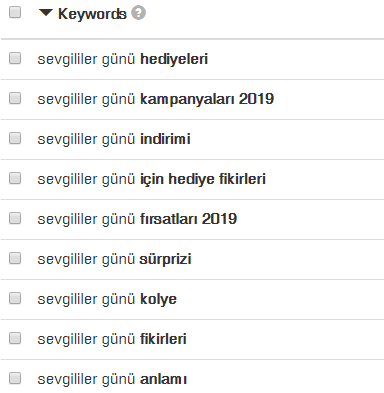
Avoid unfamiliar or rarely used jargon. Use the language your customers use.
Besides validating demand, keyword research reveals the words and phrases that potential customers use when searching for answers. Looking at keyword popularity is one of the best ways to learn to speak your audience's language.
Planning SEO Content Around the Customer
3. Which Stage of the Customer Lifecycle Does It Address?
You know what your audience is looking for and which wording matches that demand.
Now set that aside briefly and consider what the keywords you are selecting for SEO actually imply.
Put yourself in the visitor's position. If you had typed this keyword, what content would you want to find? What does the query tell you about their needs?
- Do they want to learn something?
- Are they curious about what something is?
- Do they have a problem and need a solution?
- Is it a problem you can help solve?
- Do they want to make a purchase?
- Does your business offer something directly related to the search, or a useful alternative?
Shape your SEO article around the visitor's intent. Make sure you provide what they are looking for. Google takes this relevance into account when evaluating rankings.
If you still have no clear idea and it all feels complicated:
When you cannot intuitively identify a keyword's search intent, go to Google and see how the top 10 results answer the query. Trust Google's ability to interpret search intent. If all 10 results are educational, Google considers informative, detailed pages relevant to that query.
Note: Always use more than one tool to analyze keywords and aim to offer something beyond what already exists. In particular, covering topics and using an approach that differs from other content in your market can help you build better pages.
Keep Assessing Your Competitors
4. How Well Does the Competition Serve the Searcher's Needs?
Everyone wants a place on the first page, preferably in the top position. This is a competitive undertaking. To earn a place in the position you want, you need to make your page more valuable than an existing competitor's. That means offering information, detail or solutions that improve on the current results.
To satisfy search intent, your content needs to be more compelling and do a better job than at least one of those competitors.
Look at every organic result on the first page and consider:
- Which intent does it serve: informational, transactional or another type?
- How well does it answer the query? Does it take a more comprehensive approach by covering closely related topics?
- What is the quality of the content, including its length and use of media?
- Which media tell the story: images, video, infographics or something else?
- Does it cite and link to external sources?
- Which call to action does it use: downloading content, starting a free trial, purchasing or another action?
- Is the page well designed?
5. What Would You Like the Reader to Do Next?
Your content has reached the first page. When someone clicks and begins reading, what would you like to happen?
Possible next steps include:
- Buy the product.
- Join your email list.
- Download a document in exchange for an email address.
- Share the page.
- Simply read and continue to other pages, without an immediate interaction. Later, you can reach them again through retargeting ads.
This brings us back to question 3 about search intent. The intent behind the target keyword indicates where the searcher is in the purchase funnel.
A visitor's journey can be long, and you can provide several small steps that help them move further through your sales funnel.
For example, do not expect someone looking for educational content to stop researching and immediately buy your product. They may not be ready yet, or may still be exploring their options.
You can, however, help them learn through your content and offer a useful document to download.
Earn their trust first. If they choose you again on a later visit, they may engage to obtain something they value from you. The opportunity need not be limited to that individual; it could also arrive through a recommendation.



Comments