


Image source: Freepik - Rawpixel | URL: https://www.freepik.com/free-photo/search-research-subject-terms-vocabulary_16441423.htm#query=ppc&position=22&from_view=search&track=sph
Keywords are no longer just words; they concern meaning. To improve PPC performance, you therefore need to understand phrase match in Google Ads.
Keywords and match types are fundamental to PPC, but, like almost everything in technology, they constantly change. Even experienced Google Ads specialists may find that phrase match now works differently from what they learnt earlier in their careers.
The current iteration has existed since mid-February 2021, when phrase match absorbed some functionality from broad match modifier keywords.
Before exploring the details, let us briefly review match types.
What Are Keyword Match Types?
Match types define how closely a user's query must resemble an advertiser's keyword to be eligible to trigger an ad.
- Exact match: Shows an ad only when the query is exactly the same as the keyword.
- Phrase match: Shows an ad even when extra words appear before or after the keyword.
- Broad match: Shows an ad when all keyword words are part of the search, regardless of their order.
By offering match types, Google Ads allows advertisers to show ads for searches similar to their keywords, including variations. Rather than anticipating every possible query someone might use to search for their offering, advertisers can choose flexible types such as broad or phrase match.
Close Variants
Google Ads is expanding close variants to include words with the same meaning as the original keyword.
Previously, close variants matched only queries containing at least some variation of the original keyword words. For example, “lawn”, “mowing” and “service” would match “services to mow my lawn”.
Now close variants can match queries containing none of the selected keyword words, provided they share the same meaning.
Those same keywords could therefore match a query such as “lawn mowing and gardening services”.
Think of close variants as a defined set of ways Google may alter your keyword. What looks like a single keyword in an ad group can actually represent hundreds of similar keywords behind the scenes. You do not see them, but they are all ready to serve your ad.
What Is the New Phrase Match?
Under the current definition, ads may appear for searches containing the keyword's meaning, including implied meaning, and user queries may express a more specific form of that meaning.
The major change is a shift from the words in the keyword to what those words mean. Meaning has replaced literal keywords.
For phrase match, the keyword's meaning must be part of the query, but additional text may appear.
The references to word order in the original phrase-match definition have disappeared. Google's machine learning can now distinguish when word order matters, removing the need for rigid sequencing.
This resembles the original broad match. Broad match itself has also evolved, however, and can now show ads for related searches even when their meanings differ.
The following comparison shows the differences between match types.
Revisiting the three definitions, match types in 2021 are:
- Exact match: Shows an ad when the query has the same meaning as the keyword.
- Phrase match: Shows an ad when the query includes the same meaning as the keyword.
- Broad match: Shows an ad when the query is related to the keyword.
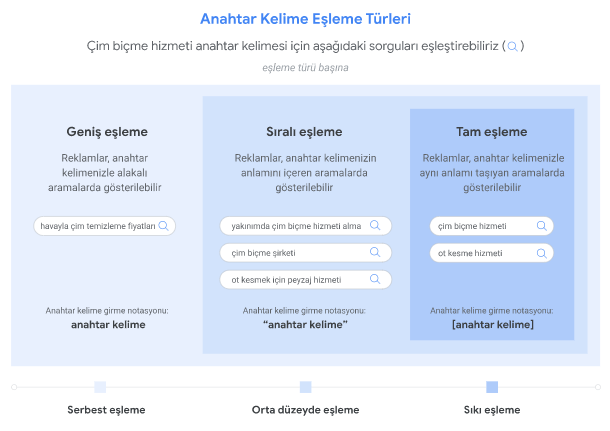
What Does Google Consider the Same Meaning?
Phrase match relies on machine learning (ML) to determine, among other things, whether changing word order changes meaning. As a simple example, it helps Google determine whether searches such as [buy chocolate milk] have the same meaning.
Does changing the order of words, including [chocolate], change the meaning?
By using phrase match, you accept that Google's machine learning will make those decisions for you.
Does it always get them right? We cannot know without monitoring. Keep checking.
Fortunately, Google separates query match types in reports.
We can therefore see when a query is a straightforward phrase match and when it is a phrase match with close variants.
Create a table report in Reporting, adding rows for “Search keyword”, “Search term” and “Search term match type”.
Some search terms will be labelled “Phrase”, others “Phrase (close variant)”. Add a filter to view only close variants and decide whether negative keywords are needed.
You can do the same for exact-match keywords.
Smart Bidding: A Partner for Phrase Match
Bid management is another form of automation you control. If you allow the advertising engine to make some matching decisions, as with phrase or broad match, you should seriously consider automated bidding.
The substantial flexibility of match types is a reason to consider bid automation.
When Google shows your ad for less relevant queries, you do not want to remain committed to bidding the same amount.
Less relevant searches may convert at a lower rate and require lower bids to perform acceptably in terms of CPA or ROAS.
Negative Broad Match Has Different Rules
Negative keywords serve a completely different purpose: excluding searches we do not want because they perform poorly or are irrelevant. They do not use close variants or expansions and are therefore much stricter about the words advertisers exclude.
They prevent ads only when the exact negative-keyword words appear in the search.
However, negative keywords have different match types.
Word order matters for negative phrase-match keywords.
Conclusion
Keywords now concern meaning rather than words alone. Advertising engines still offer a range of match types so advertisers can tell Google how flexibly or closely a query should match their keywords. Phrase match sits between exact and broad, balancing precision and volume.



Comments