


Search advertising can no longer be explained simply as bidding on the words a user types. Google’s new Gemini-powered experiences make that clear. Ads are moving closer to moments of decision, comparison and action.
How Is AI Changing Google Ads?
The transformation goes beyond automated bidding. Performance Max is only one part of it. The fundamental change is taking place in the search experience itself.
Traditional search advertising followed a simple model: a user entered a query, an advertiser bid on matching keywords, and a click took the user to a website. That model has not disappeared, but AI-supported search makes the process more complex.
Users are no longer limited to single words or short queries. Searches are longer, express intent and resemble natural language. Google therefore considers more than keyword matching: context, research stage, product-comparison needs and possible action intent all enter the assessment.
“Which keyword will I appear for?” still matters, but is no longer sufficient. The additional question is: At which moment in the user’s decision can I provide a meaningful response?
This moves search advertising from keyword management toward managing decision context.
A Gradual Transition, Not a Single Launch Day
Google’s new AI advertising ecosystem is not one product update. It will not open everywhere on one date.
AI Mode advertising, Conversational Discovery Ads, Highlighted Answers and AI-powered Shopping Ads belong to the same wave. Business Agent for Leads, Direct Offers and Universal Commerce Protocol are related developments. They do not share one timetable, market maturity or rollout speed.
A critical distinction
September 2026 is not a date when “everything changes.” It is an operational transition point at which AI Max becomes more central to Search campaigns.
Google’s September 2026 transition does not cover every AI ad format. It concerns certain legacy Search features: Dynamic Search Ads, automatically created assets and campaign-level broad match. Google will begin moving eligible campaigns using these features to AI Max.
This distinction matters. Waiting until a launch date could be costly. Brands should already prepare accurate data for AI models: product information, website content and landing-page quality, alongside clear conversion signals and brand-control rules.
Keywords Are Changing Roles, Not Disappearing
Calling this “the end of keywords” is tempting but incomplete. A better description is that keywords are no longer the sole center of the system.
AI Max for Search aims to capture broader intent signals, make ad copy more dynamic and direct users to more suitable landing pages.
Keywords remain a signal, but no longer the campaign’s only backbone. Intent, page content and product information work alongside conversion data, brand controls and AI matching.
A clear rule
Weak product data produces weak AI advertising.
This applies beyond e-commerce: B2B SaaS, fintech, education, tourism and other high-consideration sectors follow the same logic. AI can place readable information in context. It cannot recommend accurately what it cannot understand.
What Do AI Mode Ads Mean?
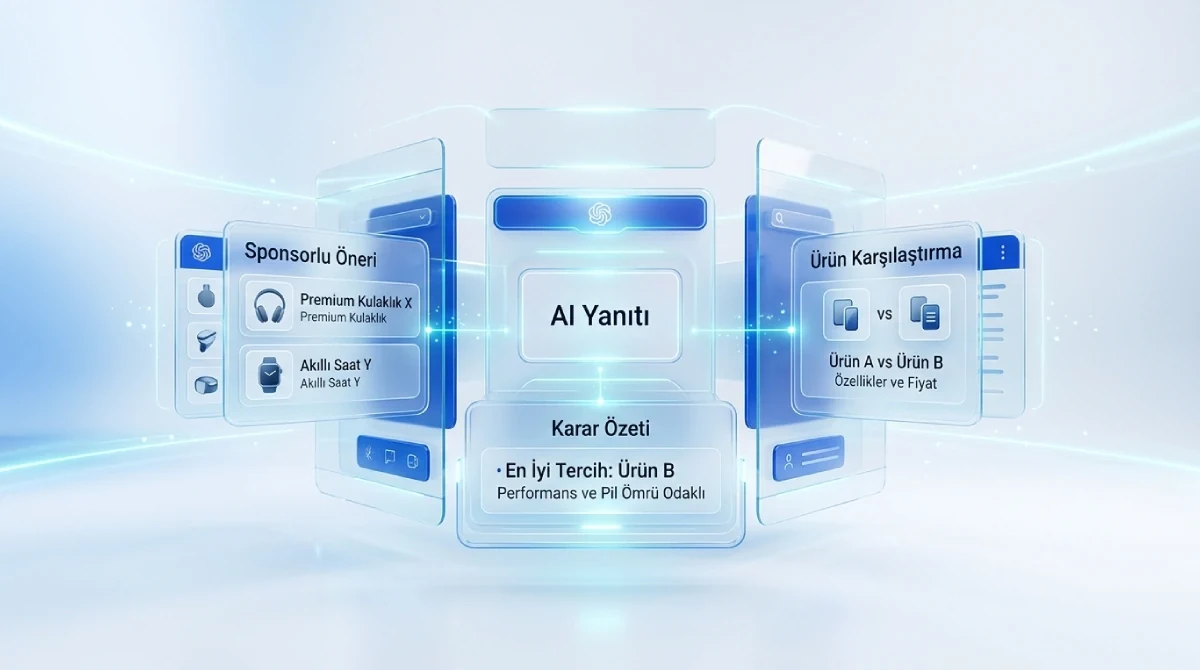
These sponsored formats appear within generative-AI search experiences. Their placement matters: they move away from the standalone link of a conventional results page and closer to the context of research and decision-making.
This requires careful explanation. Sponsored content in AI Mode should not be presented as an organic recommendation. The point is not to conceal advertising, but to place it more appropriately in context.
When a user receives an AI-supported answer about a product or service, an ad need not merely say “click and visit.” It can become a more explanatory, comparative layer of information, shaped around intent and closer to action.
What Are Conversational Discovery Ads and Highlighted Answers?
Conversational Discovery Ads are designed to accompany longer, contextual queries within AI-supported search. Rather than a static box on a results page, the format works more like a proposed solution connected to the research journey.
Highlighted Answers bring selected sponsored options into AI-generated answer experiences. Their strength lies in reaching users during evaluation before a decision.
That strength also carries risk. As advertising moves closer to the answer itself, expectations of trust and transparency rise. Users want to understand why a recommendation appears, whether it is advertising and what supports the brand’s claims.
What Are AI-powered Shopping Ads, and How Do They Affect E-Commerce?
These experiences aim to simplify decisions for high-consideration products. They can be understood as AI-supported shopping formats.
The message for e-commerce is clear: a feed is no longer just price, stock and images. Materials, uses and technical specifications matter more, along with compatibility, warranties, variants and customer expectations. Category context also enters the assessment.
Incomplete data is no longer merely a quality-score issue or a matter of weak visibility and conversion rates. A more fundamental problem can arise: AI may not understand which customer need the product meets.
AI Max: A Broader Search Automation Layer Than DSA
AI Max should not be treated simply as a new name for Dynamic Search Ads. Google positions it as a wider set of AI features focused on targeting and creative development in Search campaigns.
The September 2026 DSA transition therefore matters. It does not mean advertisers lose all control. Control shifts from keyword lists toward brand boundaries, while URL management, data quality and measurement architecture become more important.
Automation is increasing; the need for control remains.
Business Agent for Leads: Will Conversation Replace Forms?
Business Agent for Leads is particularly significant for B2B and SaaS, as well as fintech, education and high-consideration services. Users often do not want to fill in a form immediately. They first ask questions, compare, seek understanding and look for trust.
Static forms can introduce friction before those questions are answered. Fields such as name, surname, phone, company and budget may arrive too early and lose high-intent but undecided prospects.
Avoid exaggeration: forms will not disappear. Turkey’s KVKK, GDPR, consent and quotation processes remain, and CRM records and sales operations still require structured information. The form’s role, however, may change.
How Are Direct Offers, UCP and Agentic Commerce Changing Advertising?
Agentic commerce involves AI agents taking a more active role on the user’s behalf in research, comparison, selection and transactions. Previously discussed largely in theory, it becomes more concrete through Google’s UCP and Direct Offers initiatives.
Universal Commerce Protocol is emerging as an open standard for agentic commerce. Direct Offers is based on showing tailored offers to people close to purchasing.
Timing and market conditions must nevertheless be explained accurately. These are not standard tools immediately available to everyone in Turkey. They belong to the broader vision of agentic commerce and a transition progressing through retail pilots and integrations in eligible markets.
How Should Brands in Turkey Prepare?
A single launch date is a misleading frame for Turkey. AI Mode, Direct Offers, Business Agent and AI-powered Shopping Ads may arrive at different times, depending on language support, product eligibility and regional expansion. Sector regulations and advertisers’ infrastructure maturity also matter.
The right question
Beyond “When will these features launch in Turkey?”, ask: “When they do, will AI be able to interpret our data, content, feeds and measurement correctly?”
Many Turkish brands still assess advertising mainly through campaign setup, budget optimization and manual targeting. That will become insufficient. AI systems consider landing pages, product information and user signals as well as the ad account. Conversion quality, brand controls and content architecture also become performance inputs.
| Preparation area | Why it matters | Priority action |
|---|---|---|
| Data architecture | AI cannot interpret incomplete or fragmented data accurately. | Clean product, service, category and conversion data. |
| Landing-page experience | Landing pages are information sources as well as conversion points. | Add clear, crawlable and trustworthy answers to user questions. |
| Feed quality | Shopping and AI ad experiences depend on product data. | Enrich fine-grained attributes, variants and use cases in Merchant Center. |
| Measurement | Incorrect conversion signals train automation incorrectly. | Build measurement around lead and sales quality. |
| SEO and paid media integration | Organic content also supplies information to AI advertising systems. | Unite SEO, content and advertising teams around one search-experience strategy. |
What Should Advertisers Do Today?
- Enrich product and service data. Improve e-commerce feeds. For B2B, update service pages, use cases and technical explanations. Make offer details easier to read where relevant.
- Organize landing pages around user questions. Go beyond “apply now” or “buy.” Answer the questions people ask before deciding.
- Treat Merchant Center and feed quality as performance priorities. Feed management is a fundamental input to advertising performance, not merely a technical operation.
- Do not use AI Max and PMax as blind automation. Define brand controls, URL rules and copy guidelines, and monitor conversion quality closely.
- Bring SEO and paid media together around the search experience. SEO generates organic traffic and strengthens the information infrastructure used by paid media.
- Measure conversions with quality in mind. Presenting poor leads as success trains automation incorrectly. Low-value sales carry a similar risk.
Frequently Asked Questions
What are AI-supported search ads?They consider more than the keyword a user enters, adapting to intent, context, research stage and possible action needs.
How do Google AI ads differ from traditional search ads?Traditional ads rely more on query-to-keyword matching. AI ads use broader intent and contextual signals, including long queries, product data and service information.
What are AI Mode ads?They are sponsored formats within generative-AI search, closer to research and decision context. Advertising transparency must remain clear.
Is AI Max replacing Dynamic Search Ads?Google says it will automatically upgrade eligible Search campaigns from September 2026, including Dynamic Search Ads, automatically created assets and campaign-level broad match. This does not mean every AI ad format launches on that date.
Will Business Agent for Leads eliminate forms?No. KVKK, GDPR, CRM, quotation and sales processes still require them. Agent experiences can add a conversation layer before the form to inform and qualify users.
How does agentic commerce affect advertising?Agents participate more actively in research, comparison and transactions on users’ behalf. Ads therefore move beyond traffic generation and closer to offers, product selection and purchasing.
Conclusion: Advertising Is Moving Closer to the Decision
AI-supported search does not end advertising. It takes it to a more demanding, more strategic level.
Keyword lists, bidding and copy remain important but no longer suffice. Accurate product data, strong content architecture and landing-page experience become central. Clean conversion signals and a clear explanation of the brand to AI systems are also decisive.
The winning brands in future search advertising will be those AI understands most accurately, rather than simply those spending the most.
Advertisers’ task is not to wait or merely watch for Turkish launch dates. It is to prepare data and content now, and make the commerce infrastructure clear enough for decision engines to understand.
Sources and reading notes


Comments