


Being visible in AI-generated answers is not the same as earning traffic from conventional search results. An AI answer may cite a web page without sending a visitor to that page. Organic clicks, impressions, and rankings alone therefore cannot explain how often content is cited as a source in AI answers.
In 2026, Microsoft introduced an additional measurement layer through the AI Performance report in Bing Webmaster Tools. Topics Portfolio (Beta), announced on October 13, 2026, extended that analysis to topic clusters, ecosystem indicators, and opportunity queries.
The critical question, however, is not simply how many citations a topic receives. Which topics are we being cited for, which queries are we absent from, and which of those gaps genuinely justify an investment in content?
This guide explains the measurement boundaries of Bing's data and sets out a decision framework for answering those questions.
Scope note: Bing AI Performance measures visible citations in supported Microsoft Copilot, Bing AI answer, and selected partner experiences. It does not measure every mention of a brand, click, or conversion across all AI platforms.
What Is Bing AI Performance, and Which AI Experiences Does It Measure?
Bing AI Performance is a reporting feature within Bing Webmaster Tools that shows how often a website is cited as a source in supported AI-generated answers. It reports citation totals, cited pages, associated grounding queries, and changes over time. These figures are not traffic, ranking, or brand-mention counts.
Microsoft announced the feature as a Public Preview on February 10, 2026.
Its principal coverage includes:
- Microsoft Copilot
- AI-generated answers and summaries in Bing
- Selected AI integrations supported through Microsoft's partners
It is not a unified visibility database covering every answer from services such as ChatGPT, Gemini, and Perplexity.
Source: Microsoft — Introducing AI Performance, February 10, 2026
Which metrics does AI Performance provide?
Total Citations counts the times content from your website appeared as a visible source reference in AI answers during the selected period.
Average Cited Pages is the daily average number of distinct pages cited over that time range. It does not measure a page's authority or position within an answer.
Grounding Queries are query expressions associated with how an AI system retrieves information and grounds its answers in sources. The expressions shown in the report are not verbatim transcripts of every user prompt.
Page-Level Citation Activity shows citation activity associated with individual URLs. This helps connect findings at the topic or query level to actual content pages.
These indicators should be considered together. A high citation count does not necessarily mean many different pages were cited; citations may be concentrated across a small group of URLs.
Citations vs. brand mentions vs. traffic
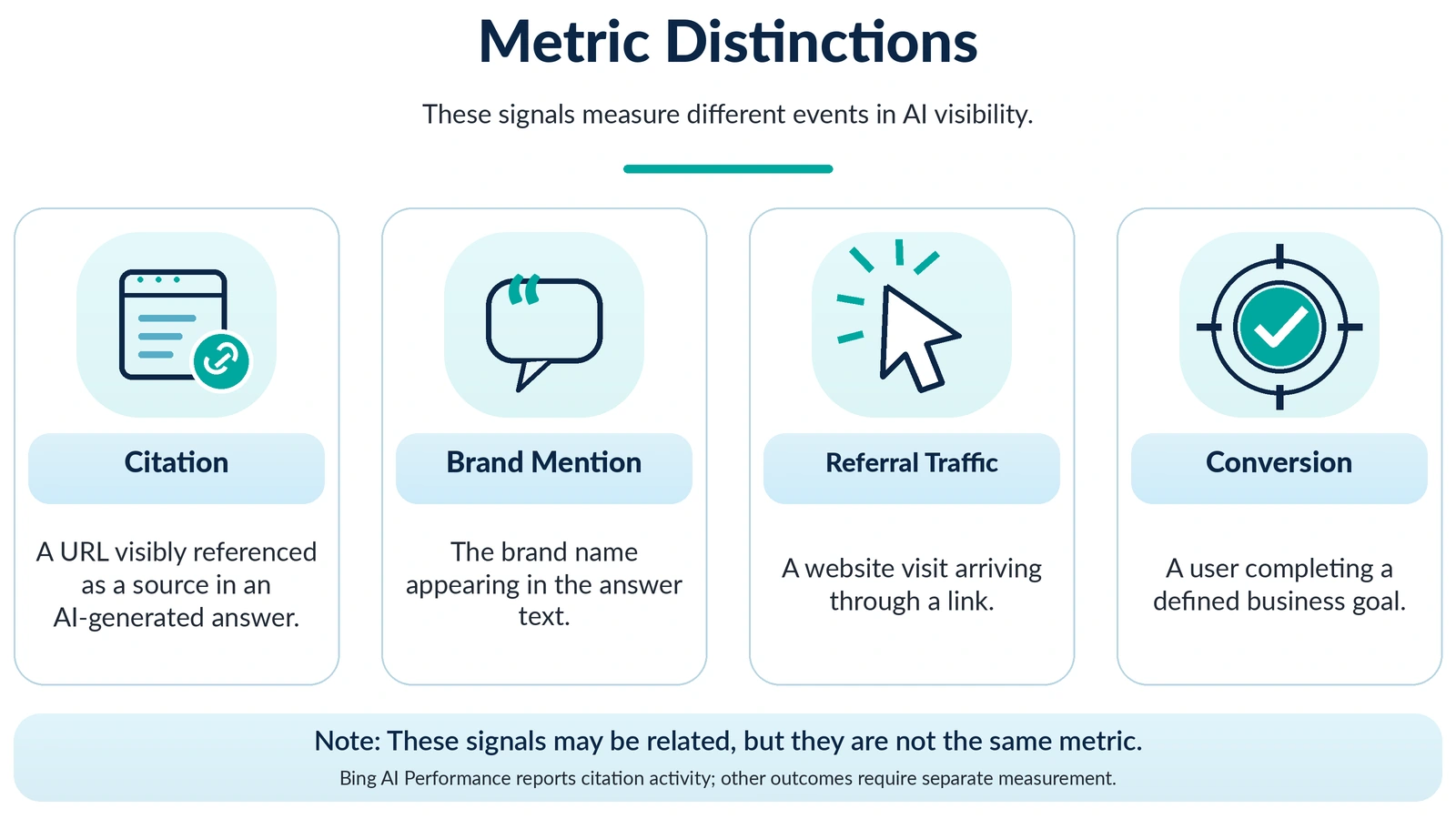
A brand name appearing in an AI answer does not establish that the answer cited the brand's website. Likewise, a cited URL does not prove that anyone clicked its link.
Four distinct events need to be separated:
| Concept | Event measured |
|---|---|
| Citation | A URL appears as a visible source reference in an AI answer |
| Brand Mention | A brand name appears in the text of an answer |
| Referral Traffic | Someone arrives at a website via a link |
| Conversion | A visitor completes a defined business objective |
AI Performance directly reports the first event. Evaluating the others requires separate data.
What Is the Difference Between Topics, Citation Share, and Topics Portfolio?
Microsoft's product updates throughout 2026 progressively expanded how AI visibility could be analyzed.
Initially, the main question was which pages on a site were being cited in AI answers. The June update added visibility into query intent, thematic relationships, and relative citation share.
Topics Portfolio, announced in October, took this analysis into the broader topic ecosystem.
| Feature | Announcement | Unit of analysis | Main function |
|---|---|---|---|
| AI Performance | February 2026 | Site, URL, query | Citation activity |
| Intents | June 2026 | Query intent | AI/ML-based intent classification |
| Topics | June 2026 | Query cluster | Group related queries into topics |
| Citation Share | June 2026 | Grounding query | Relative share of citations |
| Compare | June 2026 | Time period | Compare changes between periods |
| Topics Portfolio | October 2026 | Topic and ecosystem | Topic size, source diversity, and opportunity queries |
June 2026: Intents, Topics, Citation Share, and Compare
Intents, announced on June 16, 2026, categorizes grounding queries by informational, commercial investigation, navigational, and similar intent types. These classifications rely on machine learning. Labels should be checked manually, especially for specialized queries.
Topics groups related queries under broader themes. For example, warehouse management systems, stock tracking, and warehouse automation may fall into related topic groupings, depending on the classification applied.
Citation Share is the percentage of citations attributed to a site out of all citations attributed to sites for a particular grounding query.
Compare helps analysts review changes in citation activity between reporting periods.
Source: Microsoft — New AI Visibility Insights, June 16, 2026
October 2026: What did Topics Portfolio Beta add?
Announced on October 13, 2026, Topics Portfolio expanded topic classification with three questions:
- Approximately how much citation activity does a topic generate across the supported AI ecosystem?
- Approximately how many distinct websites are cited for queries associated with that topic?
- Which queries cite other sites but do not cite our website?
The report therefore makes it possible to examine potential citation gaps around topics, not just existing visibility.
There is an important distinction: Topics Portfolio is not a general keyword research tool that lists every missing content topic on the web. The topics displayed are related to the site's existing citation presence and activity in AI Search.
Source: Microsoft — Introducing Topics Portfolio (Beta), October 13, 2026
How Should You Interpret Topics Portfolio Metrics?
Topics Portfolio provides approximate ecosystem data at the topic level. The greatest risk is treating these values as interchangeable with conventional SEO metrics.
For example, interpreting Topic Size as monthly search volume would base a content investment decision on an incorrect assumption.
Topic Size: What does a topic's citation volume mean?
Topic Size is the approximate total number of citations across all sites for a particular topic during the selected period.
It helps indicate the extent of citation activity associated with that theme in supported AI experiences.
It does not directly show:
- Monthly keyword search volume
- Estimated organic traffic
- Number of potential customers
- Visits a new piece of content could generate
A high Topic Size alone is therefore insufficient justification for creating new content.
Sites Cited: How broad is the source ecosystem?
Sites Cited is the approximate number of sites cited for queries associated with a topic.
It provides a directional indication of how broad the source ecosystem is.
However, it does not reveal a list of competitor domains or the individual citation totals of each competitor.
A low number of cited sites does not automatically mean competition is weak. The topic may require specialist expertise, authoritative primary sources, or a narrow range of reliable documents.
Sites Cited should therefore not be used as a proxy for SEO keyword difficulty.
Queries: How many different queries belong to a topic?
Queries indicates the approximate number of distinct grounding queries associated with a topic.
It can help assess a topic's semantic breadth. It does not show how many searches took place or how many individual people asked a question.
A broad query cluster does not mean that every query deserves a separate page.
Your Grounding Queries vs. Opportunity Queries
Opening a topic in Topics Portfolio reveals two important query groups.
Your Grounding Queries lists leading grounding queries for which the analyzed site is already cited within that topic.
Opportunity Queries lists leading queries where other sites receive citations within the same topic but the analyzed site does not.
The portfolio-wide Top Opportunity Queries section brings together opportunity queries from different topics.
Citation volumes associated with opportunity queries are presented as ranges rather than exact counts.
These are candidate opportunities, not proof that every listed query represents a genuine content gap.
Which actions can these metrics support?
| Metric | Misleading interpretation | Appropriate analytical action |
|---|---|---|
| Total Citations | Our AI traffic increased | Examine the distribution of cited URLs |
| Average Cited Pages | Our authority increased | Track diversity among cited pages |
| Grounding Queries | These are real user prompts | Validate intent and URL relationships |
| Citation Share | This is our SERP market share | Compare relative visibility at the query level |
| Topic Size | This topic has high search volume | Interpret ecosystem activity alongside other evidence |
| Sites Cited | We know the exact number of competitors | Assess the breadth of the source ecosystem |
| Queries | This is the number of distinct user searches | Examine semantic coverage |
| Opportunity Queries | Every query needs a new article | Filter by relevance and existing coverage |
The actions in this table are analytical recommendations derived from the metrics, not official Microsoft instructions.
How Do You Use Bing AI Performance and Topics Portfolio?
An analysis in Bing Webmaster Tools should progress from the site level to queries and pages.
The following workflow is based on functionality described in Microsoft's announcements. It is not a record of hands-on testing within a real website property.
1. Open a verified property
Sign in to Bing Webmaster Tools and select the verified website property you want to analyze.
2. Review the AI Performance report
Check citation totals, cited-page information, and grounding queries in AI Performance.
Start by understanding the overall concentration of visibility. Then examine the URLs receiving citations.
3. Check the Topics Portfolio view
Open the Topics Portfolio view under AI Performance. Microsoft's October announcement describes this view as a tab beside Citations & Pages; the same announcement also shortens the tab label to Topics in its walkthrough.
Do not assume that a missing tab indicates a technical error. Microsoft notes that topics may not appear when there is insufficient site presence or ecosystem activity.
4. Select the analysis period
The announced Topics Portfolio options are one-, two-, and three-month windows.
The general AI Performance help documentation, by contrast, describes seven days, 30 days, three months, and a custom date range within available history.
Do not assume these two report views have identical date controls. Record the view and time window used for every analysis.
5. Evaluate the topic portfolio
Review Topic Size, Sites Cited, and Queries together.
The first question is not which topic is biggest, but which topics already have a citation presence for the site.
6. Examine queries within a topic
Inspect Your Grounding Queries and Opportunity Queries for the selected topic.
Evaluate queries that cite your site separately from those that do not.
7. Map queries to URLs
Check which pages are associated with queries already generating citations.
The AI Performance help documentation describes filtering from queries to pages and from pages to queries. Because different sampling windows may be involved, the citation totals for the same query-page relationship can differ depending on filter direction.
Do not automatically treat that discrepancy as a reporting error.
8. Filter opportunity queries
Remove navigational queries about competing brands, out-of-scope expressions, and incorrectly classified clusters.
Where appropriate, use the feedback controls Microsoft describes for inaccurate topics or opportunity queries.
9. Record the content decision and measurement context
For every relevant opportunity, document the existing URL, user intent, content gap, business value, and confidence in the data.
CSV/Excel exports are documented for general AI Performance query, page, and time-series data. Whether all Topics Portfolio beta metrics can be exported in the same way must be verified separately.
Where necessary, manually preserve the figures along with the property and date context.
How Can Opportunity Queries Reveal Genuine Content Opportunities?
Opportunity Queries adds a new signal to content research. It should not, however, be treated as a conventional keyword opportunity list.
The fact that an AI system cites other sites does not prove that your brand should publish content for that topic.
A query should earn investment priority only when three conditions hold: the subject aligns with the organization's expertise, a verifiable gap exists in current content, and closing that gap would create meaningful value for users or the business.
A four-layer analysis model: Topic, Query, Page, and Decision
Layer one: Topic visibility
Identify the relevant topic's position in the portfolio. Record the themes in which the site receives citations and their approximate ecosystem size.
This shows topic distribution; it does not yet make an investment decision.
Layer two: Query and intent analysis
Identify the actual information need behind an opportunity query.
The query may call for an explanatory guide, a product comparison, technical instructions, or brand navigation.
An AI-assigned intent label is no substitute for specialist judgment.
Layer three: Existing page coverage
Review existing pages that could satisfy the query.
Use three content states for each query:
- No Page: No suitable page addresses the user's need.
- Weak Page: A relevant page exists but does not answer the question with sufficient clarity, depth, or evidence.
- Strong Page: An existing page already satisfies the intent well; the lack of a citation cannot simply be attributed to a content gap.
Creating another page in a Strong Page scenario may cause multiple URLs to target the same search intent.
Layer four: Content and business decision
Finish by selecting an action:
Strengthen an existing page, expand a relevant section, publish a new resource, add internal links, improve product documentation, monitor the query, or reject the opportunity.
Base that choice on the nature of the information need, not citation volume alone.
The Opportunity Query filtering funnel
Before sending a query into content production, apply these checks:
- Entity fit: Is the query genuinely related to the business's products, services, or expertise?
- Intent fit: Does the user need match an actual need among the target audience?
- Existing coverage: Is there a relevant URL, and can a specific content gap be demonstrated?
- Business value: Does addressing the query support user decisions, product discovery, or business objectives?
- Ecosystem context: Do Topic Size, Sites Cited, and the opportunity citation range provide useful supporting context?
- Measurement confidence: Are uncertainty around labels, time windows, sampling, and the beta product acceptable for this decision?
The final check matters. A query appearing in one period of beta data is not definitive proof of a persistent content need.
Illustrative analysis: A B2B technology website
Illustrative scenario — all topics, queries, citation states, and content decisions below are invented for educational purposes. They are not data from a real site or a Microsoft account.
Imagine a B2B technology company publishing content about WMS, shipping planning, and ERP integration.
Assume that it receives citations for some queries across these three themes, but is absent from other opportunity queries in the same areas.
| Topic | Opportunity query | Relevance / business value | Existing content | Data risk | Decision |
|---|---|---|---|---|---|
| Warehouse management | How can warehouse stocktaking errors be reduced? | High / High | Partial coverage on WMS page | Medium | P1 — Expand |
| Warehouse management | What criteria matter when choosing a WMS? | High / High | No comprehensive selection guide | Medium | P1 — Consider a new resource |
| Shipping planning | How do you calculate vehicle load utilization? | High / Medium | Technical guide missing | Medium | P2 — Audit coverage |
| ERP integration | Data flows between ERP and warehouse systems | High / High | Related product page exists | High | P2 — Review existing URL |
| ERP integration | CompetitorX ERP login screen | Low / Low | No relevant content | High | RED — Reject |
These queries were not taken from a Bing dashboard. “CompetitorX” is a fictional brand. P1/P2/RED are not Microsoft product metrics.
Consider the first query.
If the company's WMS page already includes a section on stock accuracy, assess the adequacy of that section before commissioning a new blog post. Expanding the existing content may be more appropriate if it does not explain error causes, stocktaking methods, and operational controls.
The second query represents a different intent. The user wants selection criteria, not just a list of product features. A standalone buying evaluation guide may therefore make sense if the existing product page does not address that need.
The third query clearly calls for a technical explanation. Whether it warrants a separate page or an expanded section in an existing shipping-planning guide depends on the content inventory.
Uncertainty is higher for the fourth query. If the product page already provides a strong answer, it would be wrong to attribute the missing citation solely to insufficient content. Review the time window, query classification, and alternative explanations.
The final query represents navigational intent for a competing brand. Superficial proximity to the company's area of expertise is not a sound reason to invest in content.
Which queries should receive priority?
Use four decision categories:
P1 — First sprint: Strong expertise fit, high business value, verified content gap, and manageable measurement uncertainty.
P2 — Audit first: Relevant queries that may overlap an existing page or have insufficiently reliable data.
P3 — Monitor: Broad queries with weak business relevance or limited evidence from a single period.
RED — Reject: Competitor-brand navigation, out-of-scope subjects, incorrect classifications, or queries unrelated to the target audience.
The objective is not to assign a score to every opportunity, but to make the reason for each editorial decision auditable.
Dividing Topic Size by Sites Cited to invent a definitive AI competition score would be inappropriate. Both inputs are approximate; the resulting ratio would not measure content quality, search intent, or commercial value.
A one-hour Opportunity Query audit
A short review cycle can support the first assessment.
First 10 minutes: Record the website property, reporting date, available topics, and selected period.
Next 15 minutes: Identify the most relevant opportunity queries. Exclude competing brands and out-of-scope subjects.
Next 20 minutes: Map each query to the existing URL inventory. Assign No Page, Weak Page, or Strong Page.
Final 15 minutes: Choose P1/P2/P3/RED based on business value and measurement confidence. Document the rationale.
This exercise aims to prevent unnecessary URL creation and isolate genuine information gaps before production begins.
How Should You Analyze AI Citations Alongside GSC and GA4 Data?
Bing AI Performance, Google Search Console (GSC), and Google Analytics 4 (GA4) measure different events. Their data should not be collapsed into one performance metric.
| Data source | Primary signal | Question answered | Measurement boundary |
|---|---|---|---|
| Bing AI Performance | Citations and grounding queries | Which content is cited in supported AI answers? | Not a click or conversion report |
| Google Search Console | Impressions, clicks, and other search data | How does content perform on Google Search? | Does not measure Bing citations |
| GA4 | Sessions, traffic sources, engagement, and conversions | What do visitors do after reaching the site? | Does not count visible citations |
Why can't citations be converted directly into a traffic ratio?
A URL can be cited repeatedly across AI answers without anyone visiting the page.
The reverse is also possible: GA4 may record a referral session without a one-to-one matching citation event appearing in Bing AI Performance.
Platform coverage, measurement methodology, and data processing all differ.
Dividing AI referral sessions observed in GA4 by Bing citation totals to claim an AI CTR is therefore methodologically unsound.
Bing's report also does not measure a source's placement, prominence, or ranking within an answer.
What belongs in an executive report?
Rather than producing one universal AI visibility score, use three separate performance layers.
Visibility layer: Citation trends, cited URLs, topic distribution, and Citation Share movements for selected queries.
Content layer: Verified opportunity queries, coverage gaps, updated pages, and decisions to create new content.
Business layer: Organic traffic, appropriately identified AI referral sessions, engagement, leads, and conversions as separate business indicators.
Use four fields in the report's interpretation section:
| Field | What to record |
|---|---|
| Observation | Which measured value changed? |
| Explanation | What alternative factors could explain the change? |
| Action | Which content or technical check should follow? |
| Limitation | Which data are missing, sampled, or not comparable? |
For example, a rise in citations following a URL update does not, on its own, establish that the update caused the increase.
Query demand, changes to AI models, updates on other websites, and differences among partner systems could also influence the result.
What Are the Limitations of Topics Portfolio Beta?
Topics Portfolio offers useful new indicators for content strategy, but it is not a complete or exact log of AI citations.
Microsoft's October 13, 2026 announcement explicitly describes AI-generated topic classifications and approximate ecosystem metrics.
That does not make the data unusable. It does limit which decisions the evidence can support.
Risk, wrong decision, and protective control
| Risk | Potential wrong decision | Protective control |
|---|---|---|
| Incorrect topic classification | Create content for the wrong subject | Validate entities and intent |
| Competitor-brand opportunity | Invest in someone else's navigational query | Filter brand queries |
| Approximate Topic Size | Forecast traffic or demand from citations | Treat as an ecosystem signal |
| Low site activity | Mistake a missing tab for a technical penalty | Assess data sufficiency |
| Sampled citation data | Reconcile all report figures as exact totals | Record period, filters, and sampling limitations |
| Limited competitor information | Assume competitor domains are listed | Collect separate external evidence |
| Single-period movement | Attribute a change conclusively to an edit | Compare observations and alternative hypotheses |
Does missing data mean zero visibility?
Not necessarily.
Microsoft notes that sparse or low-volume citation activity may not appear in reports. Topics may also be omitted from Topics Portfolio when site presence or ecosystem activity is insufficient.
A query missing from the opportunity list therefore does not prove that the site has achieved complete visibility for it.
Likewise, a topic absent from the portfolio does not conclusively prove that the site's content was never used in an AI answer about that subject.
The distinction is especially important for specialist and lower-volume B2B websites.
Why isn't Citation Share a competitor performance score?
Citation Share represents a site's share of citations for a particular grounding query.
It does not identify which competitor has higher-quality content or which domain is stronger in conventional organic search.
Microsoft explicitly states that the metric is not a ranking system, competitor scoreboard, or measure of traffic share.
Changes in Citation Share should therefore not be presented as conclusive evidence of improved content quality.
How should confidence in beta data be assessed?
Assess decision confidence qualitatively rather than creating an artificial numeric score.
High confidence: Query meaning is clear, expertise fit is strong, a content gap has been independently verified, and the measurement context is documented.
Medium confidence: The subject is relevant, but query classification, URL coverage, or reporting period remain uncertain.
Low confidence: Query labels are questionable, observations are sparse, unrelated matches appear, or the content gap cannot be demonstrated.
These confidence levels are analyst-defined categories, not official Microsoft measurements. They are proposed to manage content investment risk.
A 30-Day Analysis Plan for SEO and AI Visibility Teams
Meaningful decisions from Topics Portfolio require more than opening a report. Data, content inventories, and business goals need to be reviewed together.
Week 1: Define the data scope and baseline
Identify the verified Bing property. Check access to AI Performance and Topics Portfolio.
Record the selected date range, report coverage, available topic clusters, and cited URLs.
If Topics Portfolio is missing, consider whether the data are sufficient. Check crawl and indexing health separately; do not automatically attribute the missing tab to an indexing issue.
The week's deliverable is a baseline that can support future period comparisons.
Week 2: Validate queries and content gaps
Analyze Your Grounding Queries and Opportunity Queries separately.
Categorize opportunity queries by entity fit, intent, and business value.
Map relevant queries to the existing content inventory. Classify URLs as No Page, Weak Page, or Strong Page.
Assign P1/P2/P3/RED decisions, directing production resources only toward verified opportunities.
Week 3: Make targeted content improvements
Apply focused changes to priority pages.
Answer missing user questions, clarify definitions, add verifiable evidence, and remove unnecessary repetition.
Build meaningful internal links between relevant pages. Complete missing product or service details where they belong.
Check Bing's crawling and indexing access. Consider supported notification mechanisms for content changes.
Microsoft's guidance on optimizing content for AI Search answers emphasizes clarity, context, and supporting evidence. It does not guarantee that these changes will increase citations.
Week 4: Monitor and report
Document changes by URL and date.
Re-examine citation activity and topic distribution in available comparison windows. Confirm that periods are actually comparable.
Treat GSC and GA4 data as separate performance layers.
Assign one of three outcomes to each action:
- Change observed: A metric changed, but its cause has not been established.
- No clear change: The current period offers no clear evidence of a new outcome.
- Insufficient data: More observations are needed for a reliable conclusion.
The purpose of this 30-day plan is to make reporting a repeatable decision process. Thirty days is not a guaranteed timeframe for content changes to affect AI citations.
Conclusion: What Question Should Start an AI Visibility Analysis?
Evaluating AI visibility by citation totals alone can obscure genuine opportunities across a content portfolio.
A more useful analysis asks which topics cite the site, which grounding queries and URLs are associated with that visibility, and where meaningful gaps exist.
That is the real contribution of Topics Portfolio: it places existing citation presence alongside visible opportunity queries in the same topic ecosystem.
However, being absent from citations for a query is not the same as needing to publish a new page for that query.
Content investment should be based on topical relevance, user intent, current URL coverage, business value, and confidence in the measurement.
The objective is not to collect more opportunity queries. It is to demonstrate which ones represent genuine information gaps and avoid content investments that the evidence cannot justify.
Frequently Asked Questions About Bing AI Performance and Topics Portfolio
What is Topics Portfolio, and how does it differ from Topics?
Topics, introduced in June 2026, groups related grounding queries into themes. Topics Portfolio was announced as a beta in October 2026. It extends the thematic view with ecosystem and opportunity indicators such as Topic Size, Sites Cited, Queries, and Opportunity Queries. In short, Topics organizes the query landscape; Topics Portfolio helps analyze that landscape for content portfolio decisions.
Why can't I see the Topics Portfolio tab in my account?
Microsoft notes that the feature depends on sufficient site data. Topics may not appear when citation presence or ecosystem activity is too limited. Smaller sites may therefore lack the tab. Its absence, by itself, is not evidence of a technical SEO issue, indexing penalty, or exclusion from AI systems.
Does Topic Size indicate monthly search volume?
No. Topic Size represents the approximate total citations for a topic across all sites during the selected period. It is not conventional search volume, organic traffic potential, or a user count. It may help assess a topic's relative weight in the AI citation ecosystem, but cannot independently support a return-on-investment forecast.
Do Opportunity Queries identify competing websites?
Opportunity Queries indicates that other websites are cited for certain queries while the analyzed site is not. It is not defined as a competitor intelligence tool that lists every competing domain and URL. Citation Share does not identify individual competitor domains either. Research into actual competing sources requires separate, date-stamped evidence.
How is Citation Share calculated?
According to Microsoft's definition, Citation Share is the percentage of citations attributed to the analyzed site out of citations attributed to all sites for the same grounding query. It captures relative citation visibility, not organic search market share, traffic share, a quality score, or a ranking metric.
Are Grounding Queries the exact prompts typed by Copilot users?
No. Grounding Queries are grouped expressions associated with information retrieval and the grounding of AI answers in sources. They are not full transcripts of actual user prompts. One query expression can relate to multiple pages, and one page can relate to multiple grounding queries. Treating them as verbatim user behavior logs would be misleading.
Does AI Performance measure visibility in ChatGPT and Gemini too?
Its documented scope covers Microsoft Copilot, Bing AI answers, and selected partner integrations. It is not a unified report for ChatGPT, Gemini, and all other AI systems. Bing citation data can inform hypotheses about AI search visibility elsewhere, but cannot directly establish performance on another platform.
Can Bing AI Performance data be exported?
Microsoft's AI Performance help documentation describes CSV or Excel exports for grounding query, page-level citation, and time-series data. It has not been independently verified that every beta ecosystem metric and opportunity field in Topics Portfolio can be exported with the same coverage. Check export availability in the particular report view.
Are AI citations the same as AI referral traffic in GA4?
No. A citation occurs when a URL appears as a source in a supported AI answer; referral traffic concerns visits through links. A cited URL may receive no clicks. Bing AI Performance and GA4 also cover different measurement scopes, so the two figures cannot be used to calculate a direct AI click-through rate.
Should I write a new blog post for every Opportunity Query?
No. First establish that the query aligns with the organization's expertise and target audience. Then check whether an existing page already satisfies the underlying need. Some queries justify expanding an existing URL; others may merit a standalone article. Competitor-brand navigation and incorrect classifications should be removed from the content plan entirely.



Comments